BY ROD JONES
OCU COMMUNICATIONS
Sound Design
For the sound crew of “Anastasia,� success is measured by silence. At least when it comes to hearing from the audience.
"If it’s done correctly and seamlessly, nobody notices we did anything at all," said Jacob Henry, professor and head of sound on the production. "Most people walk away saying the music sounded great or the lights were awesome, but they don't connect how it happened. We want to be unnoticed."
But staying invisible in a show as massive as “Anastasia� requires a staggering amount of visible effort, ranging from five-hour paperwork marathons to field trips involving actual artillery.
Boom quest
While most sound designers would be content with a digital library of stock sound effects, the OCU team is taking a more "explosive" approach to authenticity. To capture the sounds of the Russian Revolution, the crew headed to Fort Sill near Lawton for a live cannon demonstration.
"We’re going to go record cannons," Henry said before the trip. "You could find them online, but there’s a sense of pride in saying, 'I own this, I recorded this.' It’s authentic to us."
The signature music box, the literal "key" to Anya’s past, won't be a digital track either. The crew is recording the actual mechanical crank-and-wind of a music box belonging to one of the student's grandmothers to ensure the sound feels intimate and real.
“Just so it can sound a little more authentic, which I'm really excited for,� said Zadri Elizondo, a senior Design and Production major from Elsa, Texas, and sound designer on “Anastasia.� “You get the actual cranking. It's one of those things, too, where if it's done correctly or seamlessly, nobody notices that we did anything at all, which is kind of the point.�
The 28-mic puzzle
Logistically, Anastasia is a high-wire act. With nearly 30 actors on stage and almost all of them having at least one line, the team is pushing their equipment to the limit.
In previous shows, the crew had to coordinate mic handoffs, where actors would swap the contraptions backstage in seconds.
"It’s a nightmare. The actors hate it because it adds stress," Elizondo said.
For “Anastasia,� they have just enough mics to give every performer their own dedicated channel.
But even without handoffs, the mic plot is a massive undertaking. It is a color-coded diagram that tracks which actor is in which scene, which is important to know since each actor has their own presetting on the soundboard. A similar mic plot for a previous production took over five hours just to map out.
We’re in a tough space
The Kirkpatrick Auditorium is a beautiful venue, but can hold some challenges for a sound engineer. The room is highly reverberant, like many other historical theater venues, with little padding to soak up the noise.
"The pit sound shoots up, hits the curve of the ceiling, and smacks us in the face immediately," Elizondo explained. The job is a constant game of balance, trying to keep 27 vocalists clear and crisp on top of a 15-piece live orchestra in a room that likes to echo.
To give the production a professional edge, the department is bringing in high-quality rental speakers to replace the center cluster, giving students the chance to work with professional-grade touring equipment.
And because of Henry 's professional connections as a consultant for Lyric Theatre right up the road from campus, the production has a safety net for extra equipment and specialized knowledge.
Senior swan song
For the senior lead, this production represents the culmination of four years of "leveling up" through the ranks, from the small Black Box theater to the Main Stage. Elizondo said she has learned the ins and outs of working with the other production teams to create a hit show.
"Communication is the biggest part of this," Elizondo said. "We get rehearsal reports every night. We meet twice a week. We have to have solid communication, otherwise, it just falls apart."
See more photos of sound design work .
Music
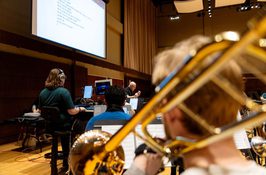
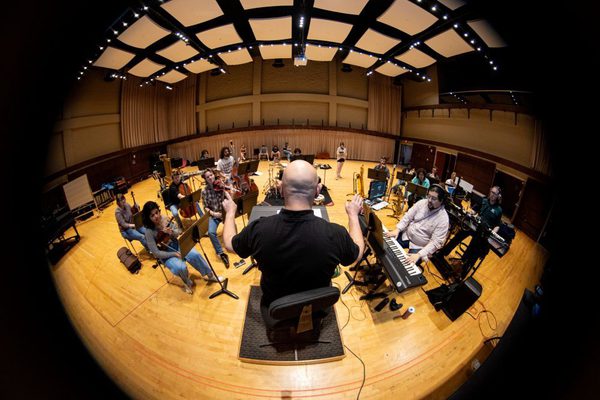
For Music Director Dr. Matthew Mailman, conducting a production like “Anastasia� is more about being a master problem solver than a high-level boss.
"I go where I’m needed," Mailman said with the calm of a man entering his 59th production at ¾Ã²Ý¹ú²ú¸£Àû. "If the singers need to see me to help coordinate, my focus is on them. If the orchestra is in a tricky sequence, I’m right there for them. I’m a facilitator."
As he prepares to lead a 15-piece orchestra through one of the most beloved scores in modern musical theater, Mailman is focused on bridging the gap between historical weight and Broadway magic.
A trio of settings
While many viewers see “Anastasia� as a story of the two halves of St. Petersburg and Paris, Mailman views the score through a more nuanced, tri-colored lens:
- Tsarist Russia: The show opens with the lush, tragic atmosphere of the Romanov dynasty. It’s the sound of an era ending in "lighter keys and gloomier undertones," woven together with traditional ballet waltzes.
- Soviet Russia: The score shifts into the heavy, rhythmic world of the Bolsheviks.
- Paris: Act Two explodes into the hopping energy of the 1920s. "The audience won't have any problem discerning the style," Mailman noted. "We move into Charleston rhythms that signal we’ve finally arrived in the land of dreams."
The ‘Wandelprobe’ advantage
In most professional theaters, the first time the cast and orchestra meet is the Sitzprobe, a rehearsal where the cast sits and sings their parts. At OCU, they skip that step entirely.
"A Sitzprobe would be a waste of time for us," Mailman said. "Our students are so capable that we move the process forward immediately."
Instead, they perform a Wandelprobe. Because the students are so well-prepared, they move immediately to the stage, singing while moving through their choreography with the live orchestra.
Pit physics
Conducting for a musical is a constant exercise in tiny adjustments as rehearsals progress. Mailman describes his role as a collaborator who adapts to the biological reality of his performers.
For singers, “they have the instrument with which they are born," Mailman explained. If a song sounds better at a tempo of 132 for one lead but 134 for the other, he adjusts. "The word 'control' is not applicable. I’m aligning with them."
Mailman throws down a tempo, but the second the singer opens their mouth, his ear is on them, making micro-adjustments in real-time.
And for dancers: “The one constant in dance is gravity," Mailman said, quoting a maxim he learned from OCU’s Ann Lacy School of American Dance and Entertainment founder Jo Rowan. Muscle memory depends on a consistent tempo for leaps and turns. "I do it the exact same every time. It’s vital for their success on stage."
Despite the "cinematic" sweep of the show, the 15-piece orchestra is a relatively easy and intimate fit for the Kirkpatrick Auditorium pit. Having once squeezed more than 50 musicians into the same space for a Poulenc opera, Mailman jokes that this year’s pit feels like "an ocean of space."
That space allows him to focus on the technical teamwork required to make the show hit.
Eternal student
Even after 31 years and nearly 60 productions at OCU, Mailman insists he is still learning. Working alongside OCU’s Oklahoma Opera and Music Theater Company directors David Herendeen and Karen Coe Miller, he views every rehearsal as a chance to grow.
"I feel like I'm their student," he said. "Every time I do a show with them, I learn something new. It’s a remarkable experience to work with this caliber of talent in the pit, on the stage and behind the scenes."
See photos from an orchestra rehearsal .
OCU’s production of “Anastasia� will be performed April 24-26 in the Kirkpatrick Auditorium, 2501 N. Blackwelder. Tickets are available at .